- by context
- by material
- by detail
- by care
- by experience
- by intention
- by change
- by logic
- by context
- by material
- by detail
- by care
- by experience
- by intention
- by change
- by logic
Moerkerk House
Moerkerk House merges architectural heritage with contemporary housing needs. The protected façade is fully restored, while later additions are removed to return the building to its original volume. A new dark-clad annex embraces the historic structure and enables a nearly energy-neutral renovation. Precise interventions maintain the character of the existing house, while the extension provides spatial generosity and future comfort. Old and new remain clearly visiible, forming a balanced dialogue in its context.
Moerkerk House is the transformation and extension of a historical protected house in Flanders. The project reconciles heritage preservation with contemporary spatial and environmental ambitions.
Rather than treating restoration and expansion as separate operations, the design integrates both into a coherent architectural strategy: the historic house is carefully restored, while a new volume embraces it, enabling renewed domestic use and improved performance.
Building on What Exists
As part of the Flemish architectural heritage, the street façade and defining elements of the house required preservation. The ambition was twofold: safeguard the characteristic identity of the building while expanding it into a full-fledged contemporary home.
The first intervention consisted of removing later annexes of limited value and restoring the original 1922 volume. This reduction clarified the historic structure and created space to add a new programme around it. The core architectural idea is simple and deliberate: the new extension does not compete with the old, but surrounds and supports it.
A Dialogue Between Eras
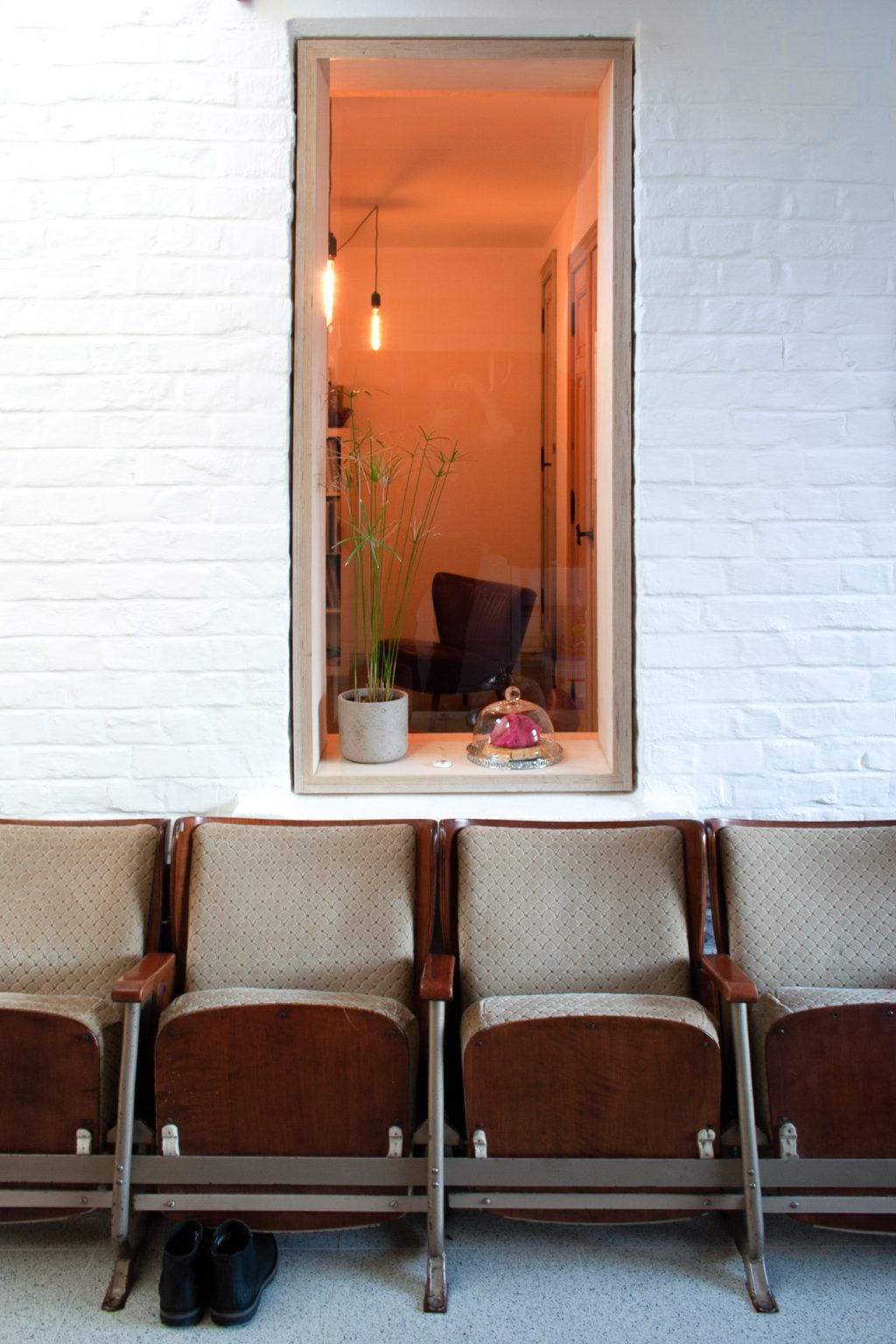
The extension accommodates contemporary living spaces and connects seamlessly to the restored house. Circulation through the new volume continuously reveals the historic façade and structure, making the past physically present in everyday life.
The contrast between both parts defines the spatial experience. The historic house retains its character and scale, while the annex offers openness and spatial continuity. Together they form a layered domestic environment that balances memory and daily use.
Contrast and Precision
Interventions in the historic fabric are executed with restraint and precision. The original exterior is fully restored, reinforcing its presence in the street.
The new volume is conceived as a clear, contemporary addition, clad in dark wood material that contrasts with the white brick façade of the existing building. This distinction ensures legibility between old and new. Structurally and spatially, the annex provides the robustness required for modern standards without compromising the integrity of the heritage core.
Framing the Existing
The new volume wraps around the historic house, creating defined outdoor zones and reinforcing the perception of the original structure as an object within a larger composition. The relationship between built mass and open space strengthens both.
Renewal Through Addition
The extension plays a key role in achieving a nearly energy-neutral renovation. By concentrating technical upgrades and performance improvements within the new envelope, the historic structure can be preserved with minimal impact.
Sustainability here lies in reuse and continuity: preserving embodied history while preparing the house for future generations.
- Year
- 2015 — 2017
- Location
- Brugge, BE
- Type
- Residential
- Status
- Built
- Program
- Renovation of a house with historic value
- Surface
- 264 m2
- Client
- Private
- Collaborator(s)
- Wim Vermeulen (structural engineering), Studiebureau Kubiek (energy management & safety)
- Year
- 2015 — 2017
- Location
- Brugge, BE
- Type
- Residential
- Status
- Built
- Program
- Renovation of a house with historic value
- Surface
- 264 m2
- Client
- Private
- Collaborator(s)
- Wim Vermeulen (structural engineering), Studiebureau Kubiek (energy management & safety)