- by context
- by structure
- by material
- by people
- by life
- by logic
- by future
- by context
- by structure
- by material
- by people
- by life
- by logic
- by future
Hotel Astoria
In Badhof Gastein (Austria), Intersoc renovated and extended an existing hotel with a new timber wing comprising 76 rooms and expanded public facilities. The project reorganises the internal logistics and introduces a new central heart between old and new. Built in prefabricated cross-laminated timber, the extension minimised disruption and significantly reduced CO₂ emissions. The architecture reinterprets the Austrian chalet typology while ensuring flexibility, circularity and long-term robustness.
A Contemporary Alpine Hotel for Collective Holidays
Since 1949, Intersoc has organised affordable mountain holidays. In Badhof Gastein, near Salzburg, the organisation renovated and expanded an existing hotel to accommodate its growing activities. The intervention includes a new wing with 76 additional rooms and the reorganisation of public, logistical and staff facilities across the complex.
The ambition was to create a coherent and future-ready hotel structure that supports both seasonal tourism and the specific animation programmes characteristic of Intersoc.
Rebalancing an Existing Structure
The site required near-complete occupation to integrate the additional programme: expansion of the restaurant to 273 seats, a new multifunctional space with bar (150+ seats), three polyvalent activity rooms, children’s play and sleep areas, ski storage, parking and technical spaces.
The central architectural idea was to restore logistical balance between the existing hotel and the extension by relocating the heart of the complex to a new inner space between both wings. This multifunctional hub connects the lobby, restaurant and activity rooms and establishes a clear internal orientation. The main entrance was repositioned to the side street, reinforcing visibility and coherence within the streetscape.
Efficiency and Clarity
Hotels depend on internal organisation. Public, semi-public and private zones are carefully structured to ensure efficient circulation, acoustic comfort and fire safety compliance. Back-of-house functions are strategically grouped to serve public areas without interfering with guest experience.
Existing spaces were reconfigured to maximise daylight and views towards the mountain landscape. The new central hall functions as a hinge between old and new, supporting both collective gatherings and independent activities.
Timber as Structure and Finish
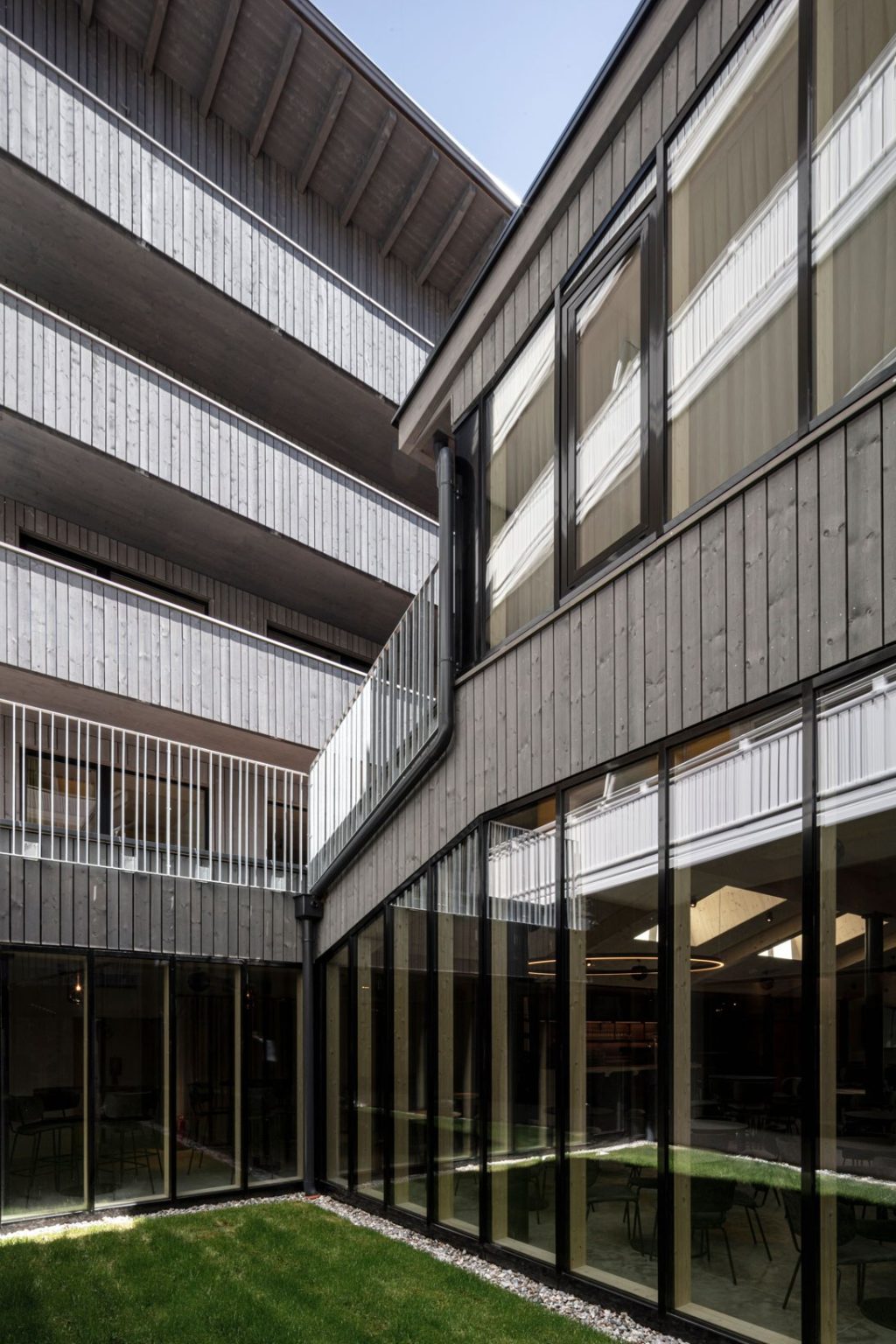
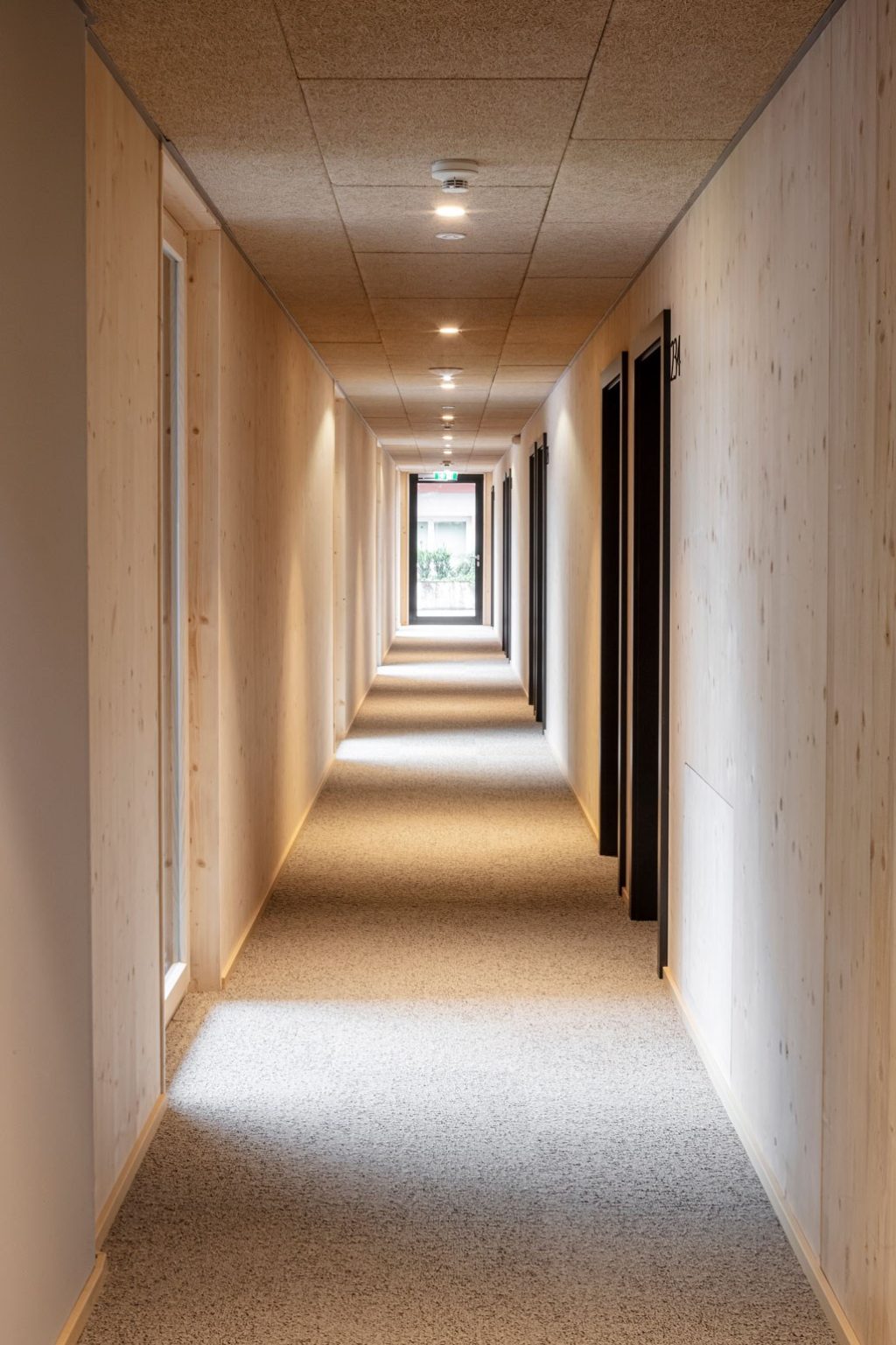
The new wing reinterprets Austrian chalet architecture through restrained detailing and material unity. Cross-laminated timber (CLT), locally produced, is used both as primary structure and interior finish. Prefabricated solid timber modules enabled rapid assembly, even under challenging weather conditions, significantly reducing disruption.
The structural and finishing layers coincide, resulting in a calm, warm interior atmosphere. The lightweight yet robust modular system enhances adaptability, demountability and long-term resilience.
Integrating with the Alpine Setting
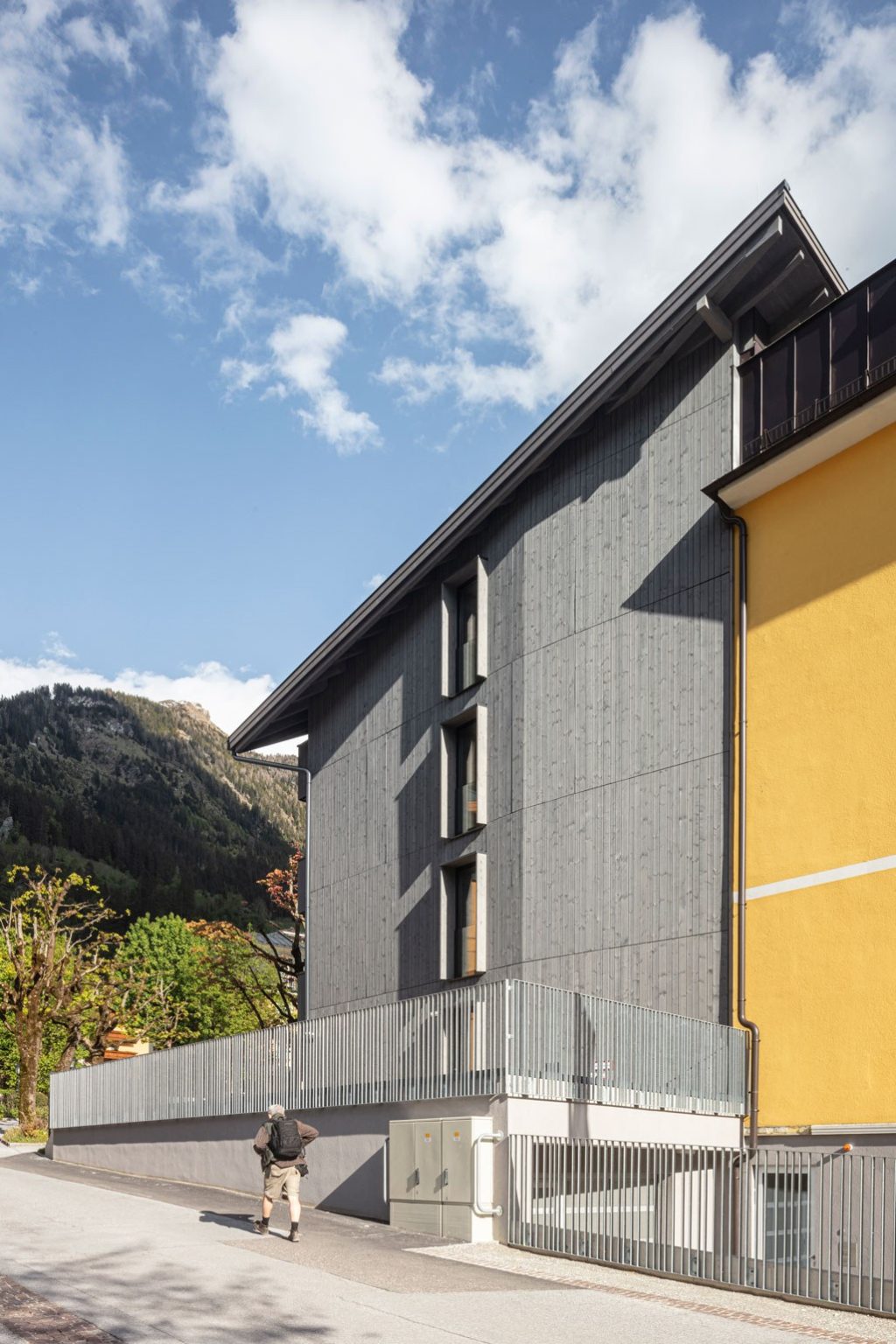
Each façade responds to its immediate context, creating varied elevations while maintaining unity through consistent material use. Timber cladding integrates the new volume into the mountainous backdrop, balancing contrast and continuity.
New terraces and reconfigured access zones reinforce the connection between interior functions and the surrounding landscape.
Circular Timber Construction
The project adopts circular design principles: demountability, flexibility, robustness and compatibility of components. Nearly the entire construction phase was prefabricated off-site, reducing waste, errors and noise impact.
By using timber as the primary structural, finishing and façade material, the project achieves a CO₂ reduction of 2,628 tonnes compared to traditional construction methods. The intervention demonstrates how modest, low-tech solutions and renewable materials can significantly reduce environmental impact while ensuring adaptability and durability in the long term.
- Year
- 2020 — 2021
- Location
- Bad Hofgastein, AT
- Type
- Health & Care + Interior
- Status
- Built
- Program
- Renovation of an existing hotel with a new hotelwing extension
- Surface
- 9.752,16 m2
- Client
- Intersoc vzw
- Collaborator(s)
- VandeAlps architecture (architecture), Ingenieurbüro Wimmer+Partner (structural engineering), Studiebureau Boydens (technical engineering), Brandl – RHZ Bau (contractor), Glocom projects (interior contractor)
- Credits
- Moare (visualisation), Rhode Van Elsen (photography), Tim Van de Velde (photography)
- Year
- 2020 — 2021
- Location
- Bad Hofgastein, AT
- Type
- Health & Care + Interior
- Status
- Built
- Program
- Renovation of an existing hotel with a new hotelwing extension
- Surface
- 9.752,16 m2
- Client
- Intersoc vzw
- Collaborator(s)
- VandeAlps architecture (architecture), Ingenieurbüro Wimmer+Partner (structural engineering), Studiebureau Boydens (technical engineering), Brandl – RHZ Bau (contractor), Glocom projects (interior contractor)
- Credits
- Moare (visualisation), Rhode Van Elsen (photography), Tim Van de Velde (photography)